About EDI (ELECTRODEIONIZATION) Plant
ELECTRODE IONIZATION
What is Electrode ionization (EDI)?
EDI is a process which combines semi-impermeable membranetechnology with ion - exchange media to provide a high efficiencydemoralization process. Electrodialysis employ electrical current and specially - prepared membranes which aresemi permeable to ions based on their charge, electrical current, and abilityto reduce the ions based to their charge.
Electro dialysis an electrical potential transports and segregatescharged aqueous species. The electrical current is used to continuouslyregenerate the resin, eliminating the need for periodical regeneration.
The EDI process produces industrial process water of very highpurity, using less than 95% of the chemical products used in the conventionalion exchange processes.
Why to choose us?
EFPL offersa wide range of sizes, materials of construction and configurations to meet allof your EDI water needs. They can be ordered either as a stand-alone unit orintegrated into the most complex of de-ionized water control systems. EDIbrings advances in both energy and operating expenses to the high purity watertreatment train.
Working Principle:
An EDI stack has the basic structure of a deionization chamber.The chamber contains an ion
Exchange resin, packed between a cationic exchange membrane and ananionic exchange membrane.
Only the ions can pass through the membrane, the water is blocked.When flow enters the resin filled diluting compartment, several processes areset in motion. Strong ions are scavenged out of the feed stream by the mixedbed resins. Under the influence of the strong direct current field appliedacross the stack of components, charged ions are pulled off the resin and drawntowards the respective, oppositely - charged electrodes. In this way thesecharged strong -ion species are continuously removed and transferred in to theadjacent concentrating compartments. As the ions go towards the membrane, theycan pass through the concentration chamber (see figure) but they cannot reachthe electrode. They are blocked by the contiguous membrane that contains aresin with the same charge.
As the strong ions are removed from the process stream, theconductivity of the stream becomes quite low. The strong, applied electricalpotential splits water at the surface of the resin beads, producing hydrogenand hydroxyl ions. These act as continuous regenerating agents of the ion -exchange resin. These regenerated resins allow ionization of neutral or weakly- ionized aqueous species such as carbon dioxide or silica. Ionization isfollowed by removal through the direct current and the ion exchange membranes.
Features of EDI (ELECTRODEIONIZATION) Plant
- Simple and continuous operation
- Chemicals for regeneration completely eliminated
- Cost effective operation and maintenance
- Low power consumption
- Non pollution, safety and reliability
- It requires very few automatic valves or complex control sequencesthat need supervision by an operator.
- It requires little space
- It produces high pure water in a constant flow
- It provides complete removal of dissolved inorganic particles
- In combination with reverse osmosis treatment, it removes morethan 99.9% of ions from the water.
Applications of EDI (ELECTRODEIONIZATION) Plant
- Reuseof residual water in food and beverages industry
- Chemicalproduction
- Biotechnology
- Electronics
- Cosmetic
- Laboratories
- Pharmaceuticalindustry
- BoilerFeed Water
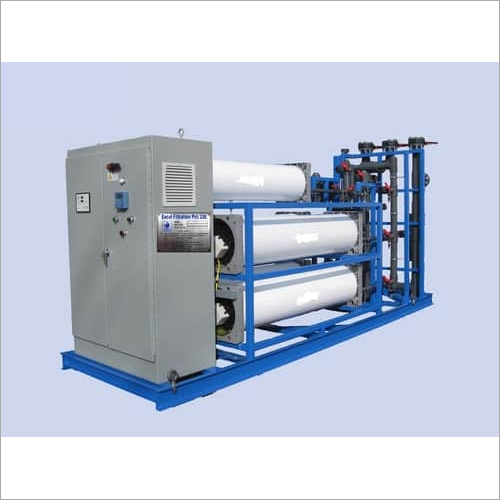
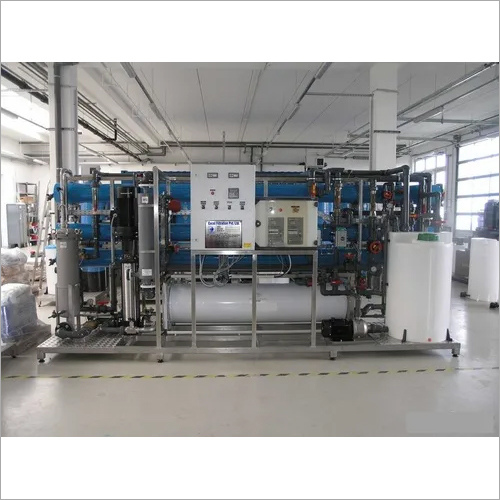
Advanced Water Purification TechnologyUtilizing leading-edge Electrodeionization (EDI) technology, this plant ensures consistent and high-purity water by combining ion exchange membranes and electrical current. The automatic operation offers flexibility, low maintenance requirements, and reduced chemical usage for safe and sustainable water treatment.
Efficiency Meets ReliabilityThe system achieves over 99% desalination and maintains high output purity with low conductivity (<0.1 S/cm). Stacked EDI modules and digital PLC controls uphold process reliability, while built-in safety mechanisms protect the equipment under various operating conditions.
Versatile Industrial ApplicationsWith capacity options ranging from 250 to 20,000 LPH and robust materials (FRP/SS304/SS316), this EDI plant serves diverse applications, including pharmaceuticals, electronics manufacturing, laboratories, and boiler feed in power plants. Its modular skid-mounted design simplifies installation and integration.
FAQ's of EDI (ELECTRODEIONIZATION) Plant:
Q: How does the EDI Plant achieve such a high salt rejection rate and product water purity?
A: The EDI Plant utilizes ion exchange membranes in conjunction with a direct electric current to continuously remove dissolved ions from feed water, achieving salt rejection rates above 99.5%. This process results in ultra-pure product water with a resistivity of 10-18.2 Mcm and a conductivity below 0.1 S/cm.
Q: What is the typical water source and application for this EDI Plant?
A: This EDI Plant is engineered to treat groundwater with a feed water conductivity of up to 20 S/cm. It is widely used in pharmaceutical manufacturing, electronics, laboratories, power plants, and for supplying ultra-pure boiler feed water.
Q: When should automatic flushing and cleaning be performed on the EDI Plant?
A: The plant features an automatic flushing system that initiates periodic cleaning cycles as determined by the PLC control system. This helps maintain optimal membrane performance and prolongs system lifespan without manual intervention.
Q: Where can the EDI system be installed, and what are the environmental requirements?
A: Thanks to its skid-mounted configuration, the EDI plant can be installed in a range of industrial settings across India, provided the ambient temperature remains between 5C and 45C and the feed water temperature is between 5C and 35C for optimal performance.
Q: What is the main process used by the EDI Plant to purify water?
A: Electrodeionization integrates electrochemical, ion exchange, and membrane-based processes. The system continuously removes dissolved ions through ion exchange membranes under an applied electrical field, eliminating the need for chemical regenerants and ensuring a steady supply of deionized water.
Q: How does the PLC control system enhance plant operation?
A: The PLC (Programmable Logic Controller) provides automated system control and monitoring via a digital touchscreen display. This enables operators to easily supervise performance metrics, initiate flushing cycles, and manage safety features such as dry run and overload protection.
Q: What are the main benefits of using this EDI Plant for water treatment?
A: Key benefits include consistent ultra-pure water output, high water recycle rates (up to 92%), minimal chemical usage, low energy consumption (<1 kWh/m3), robust construction, and continuous operation. The system's versatility supports diverse industrial requirements while promoting environmental sustainability.

 English
 Spanish
 French
 German
 Italian
 Chinese (Simplified)
 Japanese
 Korean
 Arabic
 Portuguese

 Send Inquiry



 Send Inquiry



 Send Inquiry
 Send SMS
 Call Me Free
